The Delta Tunnel, formally known as the Delta Conveyance Project, is the latest version of a decades-old plan to send more water from northern to southern California. It would move Sacramento River water around (or in this version, under) the Sacramento-San Joaquin Delta to a new pumping plant in the south Delta, near the existing pumps that already export millions of acre-feet of water each year to the San Joaquin Valley and Southern California.
In 2024, the Department of Water Resources (DWR) petitioned the State Water Resources Control Board to issue a permit for two new diversion intakes on the lower Sacramento River, each capable of diverting 3,000 cfs into a new tunnel that would convey the water to a new set of State Water Project pumps in the South Delta. Friends of the River and its allies – who had previously sued over DWR’s inadequate 2022 Environmental Impact Report over its failure to describe or analyze Tunnel operations, evaluate project impacts outside the Delta, consider water supply alternatives that reduce reliance on the Delta, or incorporate protections for California’s rivers – is protesting that petition.
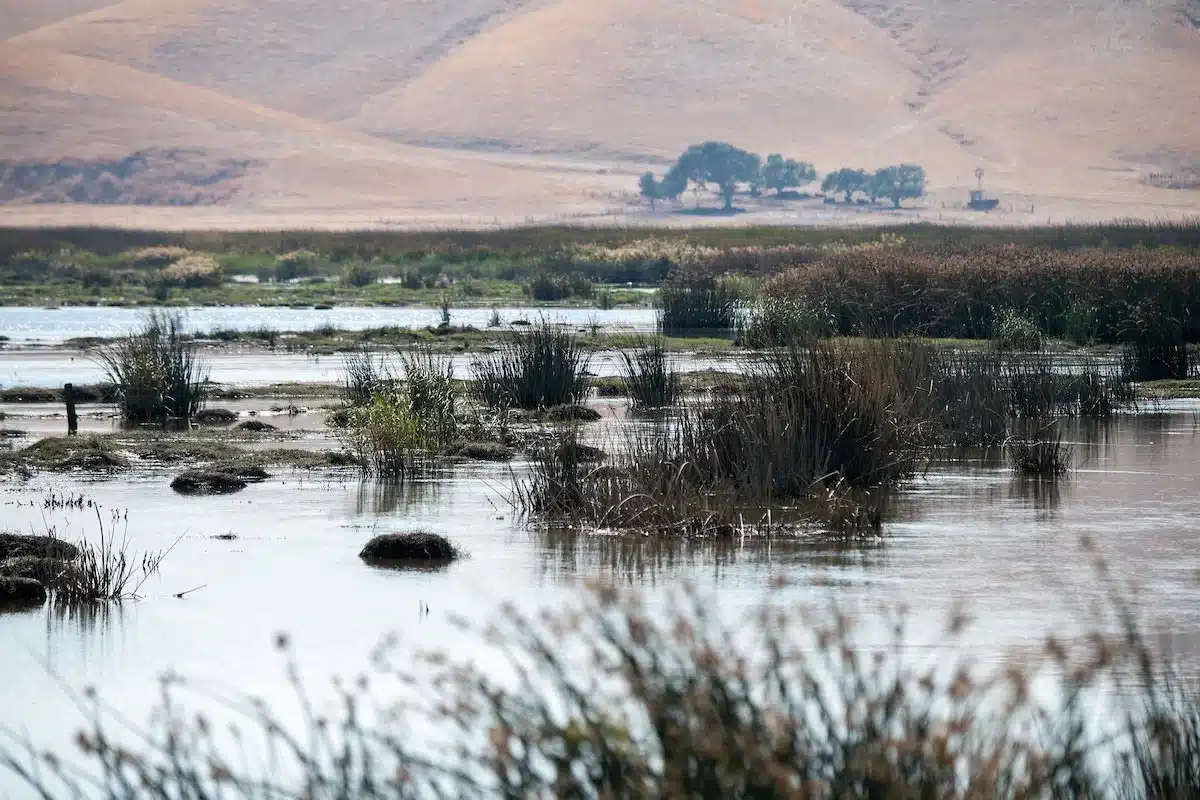
The San Francisco Bay-Delta Estuary is a mosaic landscape, supporting numerous wildlife and human uses. Nurse Slough. 2022. Credit: Ken James, CA Dept of Water Resources.
Environmentally Damaging, Way Too Expensive, and Not Needed
- Increasing the capacity to take more water from the Delta will damage the already-stressed ecosystems of northern California rivers and the Delta, and the water quality, wildlife, fisheries, and communities that need them. About half the average annual flow from Central Valley rivers is currently diverted before it can reach San Francisco Bay – with devastating consequences for water quality, endangered species, commercial and recreational fisheries, and all of us that depend on a healthy Bay-Delta ecosystem. The Delta Tunnel will only make that situation worse.
- The Tunnel is not needed to meet Southern California’s water supply needs – and it’s actually inconsistent with State policy that requires reducing Southern California’s reliance on the Delta for water supply. Instead, it’s an an expensive boondoggle that will probably cost between $60 billion and $116 billion – three to six times the State’s estimated cost.
- The Tunnel project is being pushed forward without analyzing how it would operate, how climate change would impact it, or even how much water the project can legally take.
FOR’s expert witnesses expose the Tunnel project’s shortcomings
- Project Drawdown senior scientist Dr. Christina Swanson shows how DWR seriously underestimates the impacts of climate change and overestimates the effectiveness of its fish screens. While justifying the Tunnel project as a necessary measure to combat a hotter, dryer future climate, DWR’s modeling assumes a wetter climate – misrepresenting the potential benefits and impacts of operating the Tunnel – and fails to look beyond the near future. And the agency assumes that the Tunnel’s giant fish screens will prevent harm to fish and wildlife, even though those screens have never been tested in real life and the modeling evaluated impacts to only one fish species.
- Pacific Institute researcher Heather Cooley Heather Cooley lays out the case for an alternative approach to managing water supply for Southern California by documenting significant opportunities to reduce reliance on water exports from the Delta through reductions in inefficient water use and increases in local and regional water supplies from more efficient indoor and outdoor water use practices, water reuse and recycling, and stormwater capture.
- FOR senior policy analyst Ron Stork explains how the Tunnel’s expanded Delta export capacity provides a powerful incentive for the construction of new or expanded surface storage dams and reservoirs in California, from currently active proposals like the 18-foot raise of the Shasta Dam and the Sites Offstream Reservoir Project in the Sacramento Valley to the revival of older proposals that were part of the original vision for the State Water Project.
- American River business owner and whitewater enthusiast Charlie Center points out that the potential for increased water transfers from Central Valley rivers using the new Tunnel is much greater than described by DWR, and that the combination of increased sales and new or expanded water storage facilities on these rivers will further harm the ecology and interfere with local recreation and economic activities.
In June 2026, FOR presented rebuttal testimony from Dr. Swanson that refuted the attacks in DWR's rebuttal testimony on her findings about the uncertainty of how effective giant new fish screens would be and about DWR's errors in minimizing environmental and climate change impacts of the Tunnel. We also presented rebuttal testimony from Ms. Cooley that pulled the rug out of the Metropolitan Water District's rebuttal testimony questioning her cost estimates for water conservation programs.
Financing the tunnel
On December 31, 2025, the Third District Court of Appeal upheld the 2024 Sacramento County Superior Court decision that DWR lacked the authority to validate bond resolutions and revenue pledges for the Tunnel. According to the appellate judges, the scope of the “Delta Program” for which DWR sought to validate bond financing “is so opaque and ill-defined as to afford DWR nearly unlimited discretion to specify the facilities for which the bonds will be issued” and that “the Bond Resolutions would give DWR authority to issue an unlimited amount of bonds to finance the work.”
That’s one more crack in the wall of delusion built around this environmentally harmful and economically irrational project.