Managing Water for the Future
California doesn’t have a drought problem—it has a water management problem. We’re working to fix that.
California often makes headlines for water woes, but the real problem California faces is overuse of its water supply. There are many ways to use water more efficiently and to reduce the excessive demand for water in order to provide a lasting water supply to California’s communities, economy, and environment.
One key opportunity for progress is to promote local solutions in water supply management. Under our current system, water is transported hundreds of miles across the state, mostly from north to south. This is expensive, requires pumping that consumes vast amounts of energy, and is vulnerable to disruption from water shortages, ecosystem stress, and climate change. In addition, exporting so much water across the state dramatically reduces natural runoff, with devastating impacts to the environment and communities that call the Bay-Delta estuary and the rivers that feed it home. In contrast, expanding water use efficiency practices, water reuse and recycling, and other actions can insulate communities from the effects of climate change, natural disasters, and other threats. This is not only good sense, it’s State policy. In 2009, the state legislature added Section 85021 to the Water Code, which requires “the State of California … to reduce reliance on the Delta in meeting California’s future water supply needs through a statewide strategy of investing in improved regional supplies, conservation, and water use efficiency.”
Making each drop of water do more means healthy rivers, healthy communities, and a healthy economy can coexist. Although California has made significant progress in using water more efficiently, there is still great potential for using the existing supplies even more efficiently and increasing the amount and reliability of dry year water supply through a wide variety of measures. The total of all these measures combined would be equal to more than half of the state’s current water use. That’s plenty of water to accommodate all our population needs while also reducing our reliance on the Delta and our rivers. Nearly all these measures are less expensive, and politically and environmentally less disruptive, than building new dams. Many have the added benefit of reducing energy costs and improving water quality.
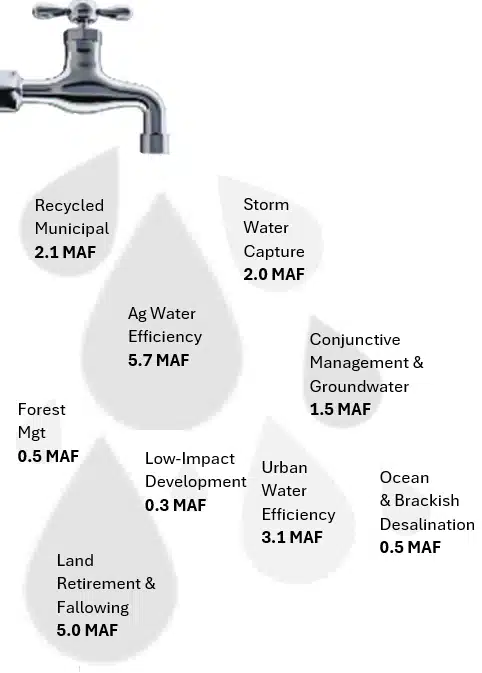
Potential sources of local water supply could cumulatively add millions of acre-feet of reliable, long-term water for California. Add in replenishing our depleted aquifers, and together the potential water savings dwarf the relatively small yield from a dozen giant new surface storage reservoirs.
Local water solutions are more affordable and more resilient
The cost of local water projects are often lower than traditional concrete and steel solutions like new dams and new aqueducts. Financing for proposed multi-billion dollar projects like Sites Reservoir and the Delta Tunnel rely heavily on state and federal subsidies that load the cost burdens onto taxpayers—even ones that will never receive water from these projects. If equivalent levels of public funding were directed to local water projects, more reliable water supplies and healthier rivers would result, with lower costs and more equitable outcomes for the majority of Californians. That’s why Friends of the River supports large scale investments in water reuse and water recycling like the Pure Water Southern California project, and has worked to platform these ideas in the permitting processes for environmentally damaging projects like the Delta Tunnel and Sites Reservoir. For instance, read FOR expert witness Heather Cooley’s testimony on better water supply options than the Delta Tunnel here.
Investments in local water supplies by Southern California and other urban areas that currently rely on imported water also make these areas more resilient to earthquakes that could sever aqueducts and canals carrying imported water supplies. For more detail on how Southern California can droughtproof its supplies and reduce pressure on overallocated river systems, see the recommendations in “A Resilient Urban Water Plan for California.”
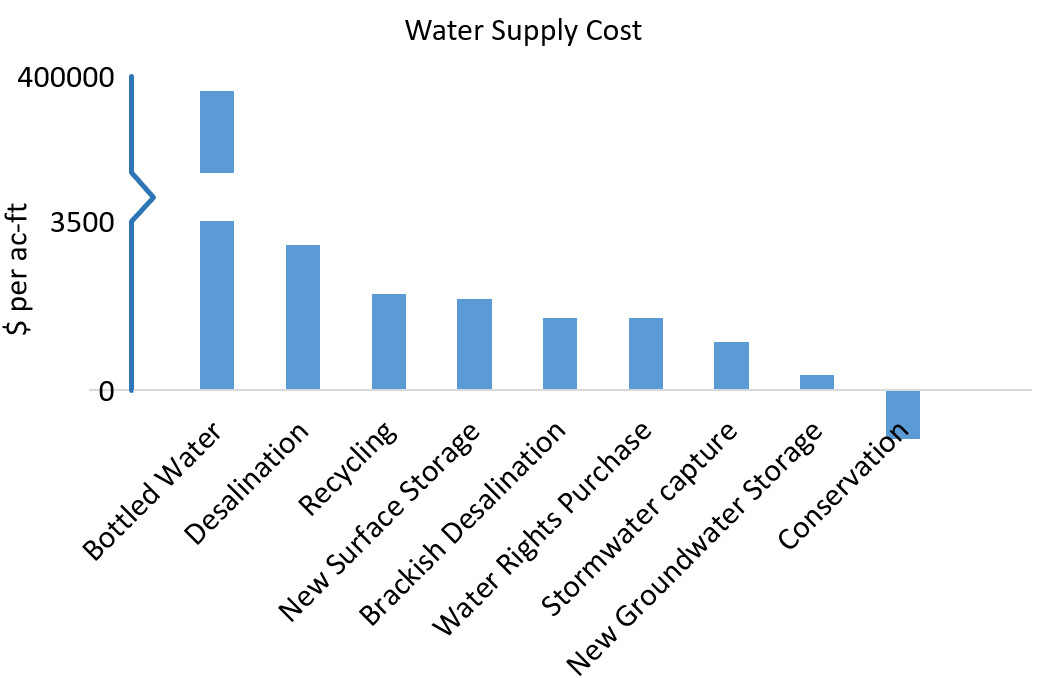
Californians are experiencing rising water costs, with the biggest increases often due to mismanagement or poor investment choices. Low-income households are disproportionately burdened by these increases. The mix of water supply sources chosen by each urban water agency can significantly affect water costs, as this graph shows. Running out of drinking water is costly too—bottled water can cost $360,000 per acre-foot. The most cost-effective approach to saving water is a wide range of water conservation options.
The biggest opportunity is replacing water-hungry landscapes with water-conserving ones. Doing so actually has a negative cost—meaning it saves money for households and utilities.
Desalination, or removing salt from ocean water, is energy-intensive and is thus the most costly, but it can work for small, isolated water systems that can afford the high cost (e.g. Catalina Island). New dams and water recycling have similar price tags, but the environmental damage from dams vs the resiliency of water recycling during droughts make water recycling the clear winner between the two.
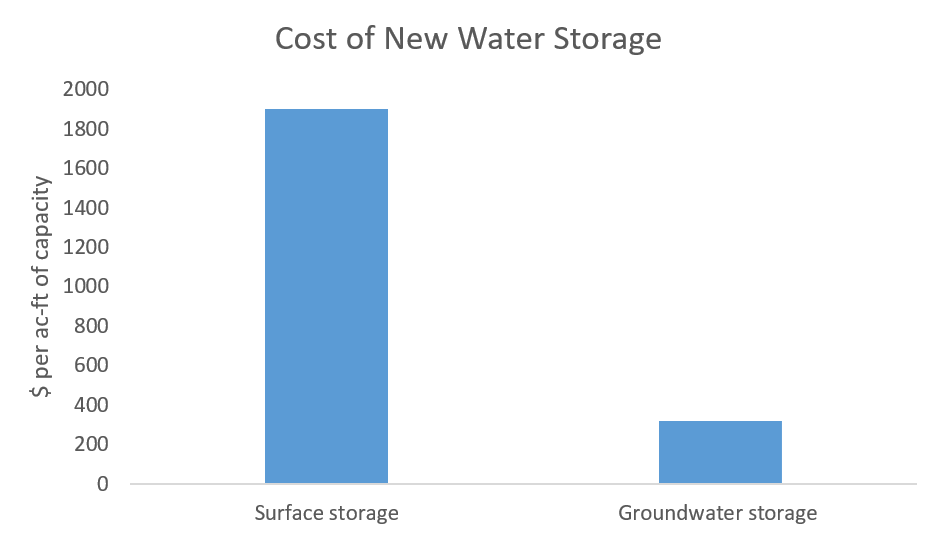
Storing water in aquifers is also far more cost-effective than building new reservoirs, and is also the ecologically superior choice due to the devastating impacts reservoirs have on rivers and terrestrial ecosystems.
Groundwater storage is also safer than building dams, does not require as much maintenance or decommissioning costs, and saves water by eliminating evaporation.
Transporting water long distances uses a lot of energy
Southern California urban water users can not only save money by investing in local sustainable supplies, but they can also save energy and lower greenhouse gas emissions. Water is heavy and pumping it uphill over mountains to reach Southern California takes a lot of energy. Imported water is costly and polluting, and the graph below shows the relative energy intensity of various sources.
Agriculture can – and must - thrive with less water
What about agricultural water use, which after all uses 80% of the state’s developed water supplies? In order for California to balance its water budget, the agriculture industry must reduce its overall use of water.
Luckily, a diverse portfolio of options exists for the industry to both use less water per acre and to repurpose irrigated lands to other, less water intensive uses. To increase efficiency, growers can shift to crops that require less water and take advantage of new technologies to decrease evapotranspiration (evaporation that happens when plants breathe). In many areas, especially in the semidesert areas on the west side and south end of the San Joaquin Valley, the advent of imported water supplies facilitated the expansion of irrigated agriculture into areas that have soils with poor drainage, high salt levels, and other qualities that make them a poor choice for farming. These lands must eventually be retired due to increasing soil salinization and rising shallow groundwater levels. But that doesn’t make the land useless! It can be used for dryland farming (which was prevalent prior to large-scale importation of water for irrigation), wildlife habitat reserves, and alternate economic activities like solar energy facilities, and more. These can provide the basis for a sustainable and viable economy in these areas.